CIN Code: IT058091B7FBOZT2HE
The Domus Sessoriana, adjacent to the Basilica of the Holy Cross in Jerusalem, is located in the Esquiline District, close to the Aurelian Walls and the Castrense Amphitheater. Its name derives from the Sessorian Palace, a complex that from the 3rd century AD was the residence of the last emperors, from Septimius Severus to Constantine. According to the Liber Pontificalis, Constantine transformed part of the building into a Christian basilica to house the relics of the Holy Cross found on Mount Calvary.
Home of emperors
The Basilica built during the age of Constantine as Sanctuary, similar to those erected in the Holy Land. That place had witnessed the death and Resurrection of Jesus. This Roman Jerusalem hold and offers to Christians the relics of the Passion of the Lord, found on Calvary hill and brought to Rome by Elena, Emperor Costantine’s aging mother: a part of the Cross, the nail, the Titulus and the thorns. The Church was constructed in a large hall of Sessorium, the imperial residence in wich Helena resided. Due to this fact, the Church was referred to as helenina basilica or Sessorian Basilica. It was an open site of Christian worship, as shown archeological excavations of the 90s. The complex underwent an initial renovation in the 8th century under Popes Gregory II and Hadrian XII, but it was not until the 12th century, under Pope Lucius II, that it underwent a radical renovation, with the creation of three naves of the basilica, the addition of a bell tower, and the portico. During its sixteen centuries of history, the Basilica has continually renewed.
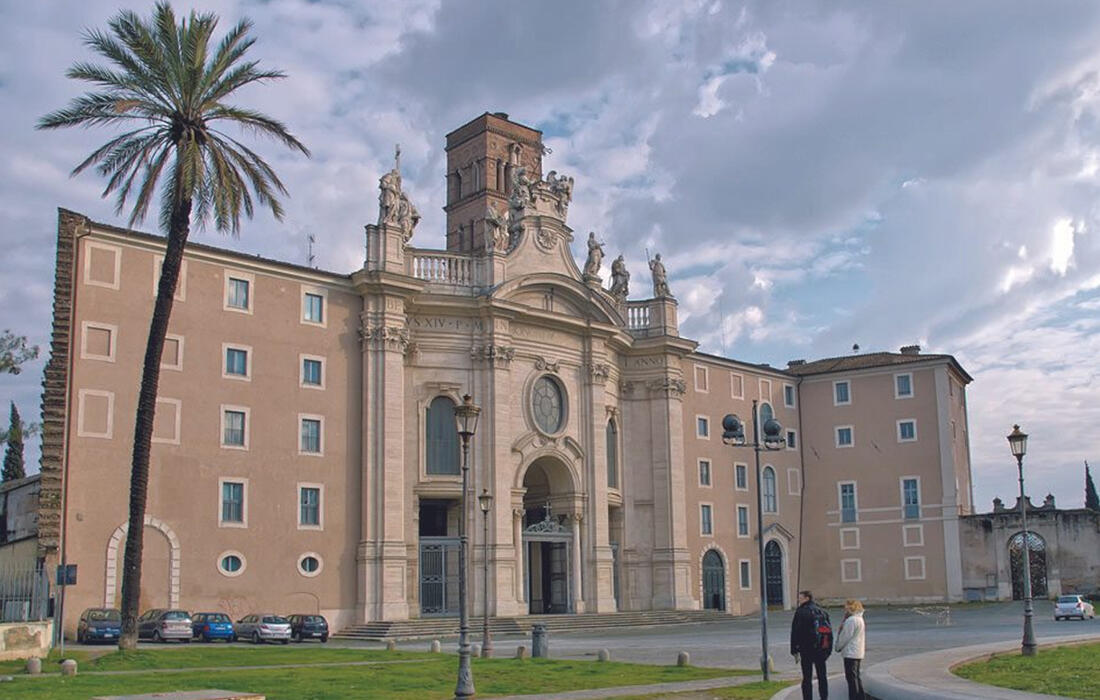
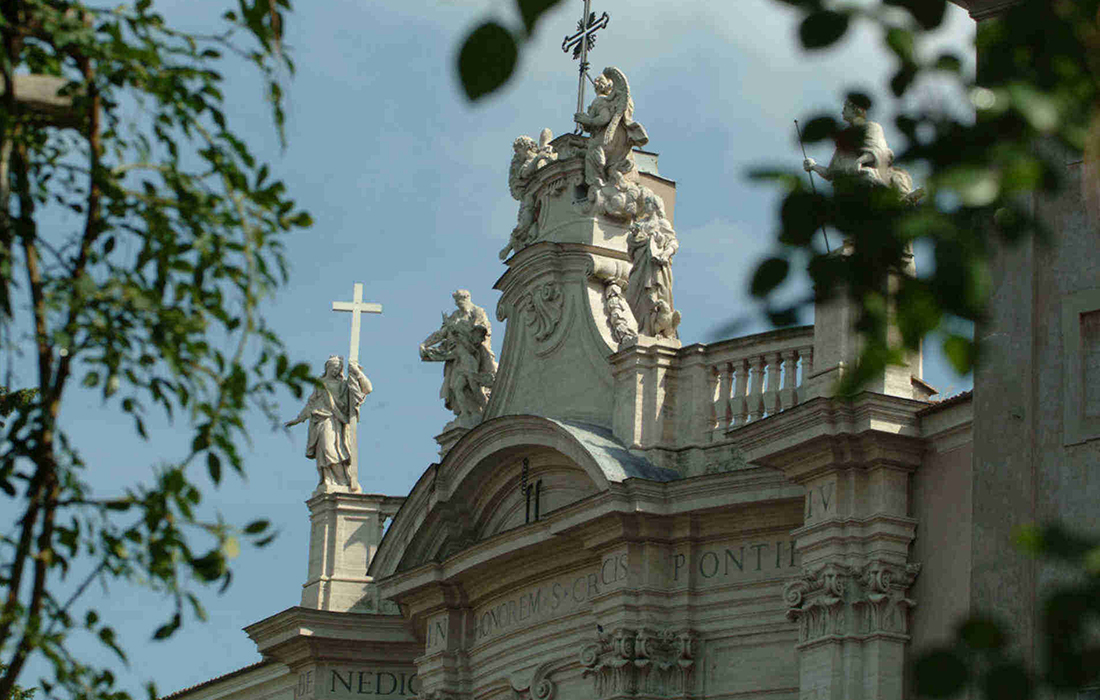
Furthermore in the tenth century the monastery was annexed. They took turns until 2009 the benedictines, the Canonici from San Frediano, Carthusians and Cistercians. In the 18th century, Pope Benedict XIV renovated the building again, commissioning architects Pietro Passalacqua and Domenico Gregorini to incorporate the Basilica into the Domus, modifying it internally and externally. They created an elliptical atrium with three entrances and replaced the medieval façade with a modern, dramatic travertine façade. This follows the Baroque style, alternating concave and convex volumes that characterize the continuous scenic backdrop overlooking the Piazza di Santa Croce in Gerusalemme, which still exists today.
To the right of the atrium of the Basilica are two doors: the one with a travertine tympanum provides access to the Parish of Santa Croce in Gerusalemme, established in 1912 by Pope Pius X, while the arched door provides access to the Domus Sessoriana, currently used as a hotel. Both doors will be restored
Everywhere works of art
The Basilica contains notable artworks: the medieval frescoes in the attic; floor Cosmatesque style, the typical geometric stonework of Roman marble of the twelfth and thirteenth century, made of polychrome marble inlays; the apse decorated with the cycle attributed to Antoniazzo Romano, one of the leading exponents of the Roman school of the Renaissance, depicting the Story of the True Cross, Christ blessing and the discovery of the relics of the Cross; paintings by Raffaele Vanni, Luigi Garza, Carlo Maratta and Giuseppe Passeri and Corrado Giaquinto. Some original frescoes are preserved in the Museum, werheas some paintings are posted in the stairwell of the Conventual Wing of the building.
Frescoed chapels
Behind the apse there are two chapels, one on the left is dedicated to Saint Gregory, the right one dedicated to Saint Helena. The ancient Cubiculum Sanctae Helenae was, according to historical reconstructions, the private room of the Empress in the Sessorium, where the relics have been preserved for more than a millennium and where the floor was strewn with the land of Calvary. The Chapel is decorated with frescoes by Nicolò Circignani (Pomarancio, XVI sec.), dedicated to the True Cross. On the ceiling there is a wonderful mosaic, depicting the Blessing Christ, the Evangelists and episodes related to the Cross. This mosaic, dating back to the sixteenth century and by Baldasarre Peruzzi, perhaps designed by Melozzo da Forlì, shows for the first time, the parrot and toucan. In the Chapel there is a statue of St. Helena, a copy of Vatican Juno, properly adapted with the symbols of the Passion.
This location, however, did not allow for easy flow of piligrims who became more numerous in modern times. For this reason, during the Holy Year of 1925, it was decided to build a larger chapel with more room and easier access. The present “Sanctuary of the Cross” was buit in the ancient Sacristy of the Basilica on design by architect Florestano Di Fausto. The idea behind the work is that of a pilgrimage to Calvary meditating on the mistery of the Passion and Death of Jesus, a theme that is particularly well expressed by the symbols on the route. Climbing the stairs one recalls the Passion of Jesus with the Stations of the Crucis alternated with citations from the New Testament and the Liturgy of Holy Friday, at the end, from the Vestibule and beyond an iconostasis reaches the vision of the Relics held in six precious Reliquaries realized all or in part during the course of the 1800s to substitute the ancient ones confiscated by the Roman Republic in 1798. To complete the catechesis of the Passion that the Relics suggest, in a room next to the Chapel, a life sized copy of the Sindone is located.
The Relics
In 326 DC Helena, mother of the Emperor Costantino, took a trip in Palestine. It may have been a mission to inspect the churches of the East for her son, or maybe just a desire to take a pilgrimage. However after her trip at the end of fourth century, legend began to attribute her with the rediscovery of the instruments of the Passion on Calvary Hill. How was it possible that she identified the true cross? Helena searched for the inscription and with the help of the evangelical writing she found: the titulus that Pilate had attached to the cross, Jesus of Nazareth King of the Jews, with the reason for his condemnation. Later it is said that Helena divided the cross into three parts: she left one in Jerusalem, one was sent to her son in Costantinople and she took the third to Rome, together with the other relics of the Passion and a large quantity of earth from Calvary, which she used to cover the pavement of the chapel that was later dedicated to her in the Roman Hierusalem built in the Sessorian palace. The Relics of the Passion of the Lord were conserved and venerated for over a millennium in the semi-underground chapel dedicated to St. Helena. To save them from the humid environment, they were moved from the ancient cubiculum sanctae Helenae and with the permission of Pius V transported to a drier and more secure place: the chapel of St. Helena. The access path to the chapel was through the monastery, thus women entering would have violated the cloister and risked excommunication. The prohibition was removed only in 1935, by pope Pius XI.
The Thorns
At Holy Cross there are also two Thorns that are retained as having come from the crown of thorns that Jesus wore. This relic was already venerated in Constantinople during the era of Justinian. The two thorns are similar to the thorns conserved in other churches: are straight, woody, pointed and long about 3,5 cm. During the course of the centuries Holy Cross was enriched with other relics including fragments from the grotto in Bethlehem, from the holy sepulchre and from scourging post, as well as the patibulum of the Good Thief and the finger of St. Thomas.
Amphitheatre Castrense
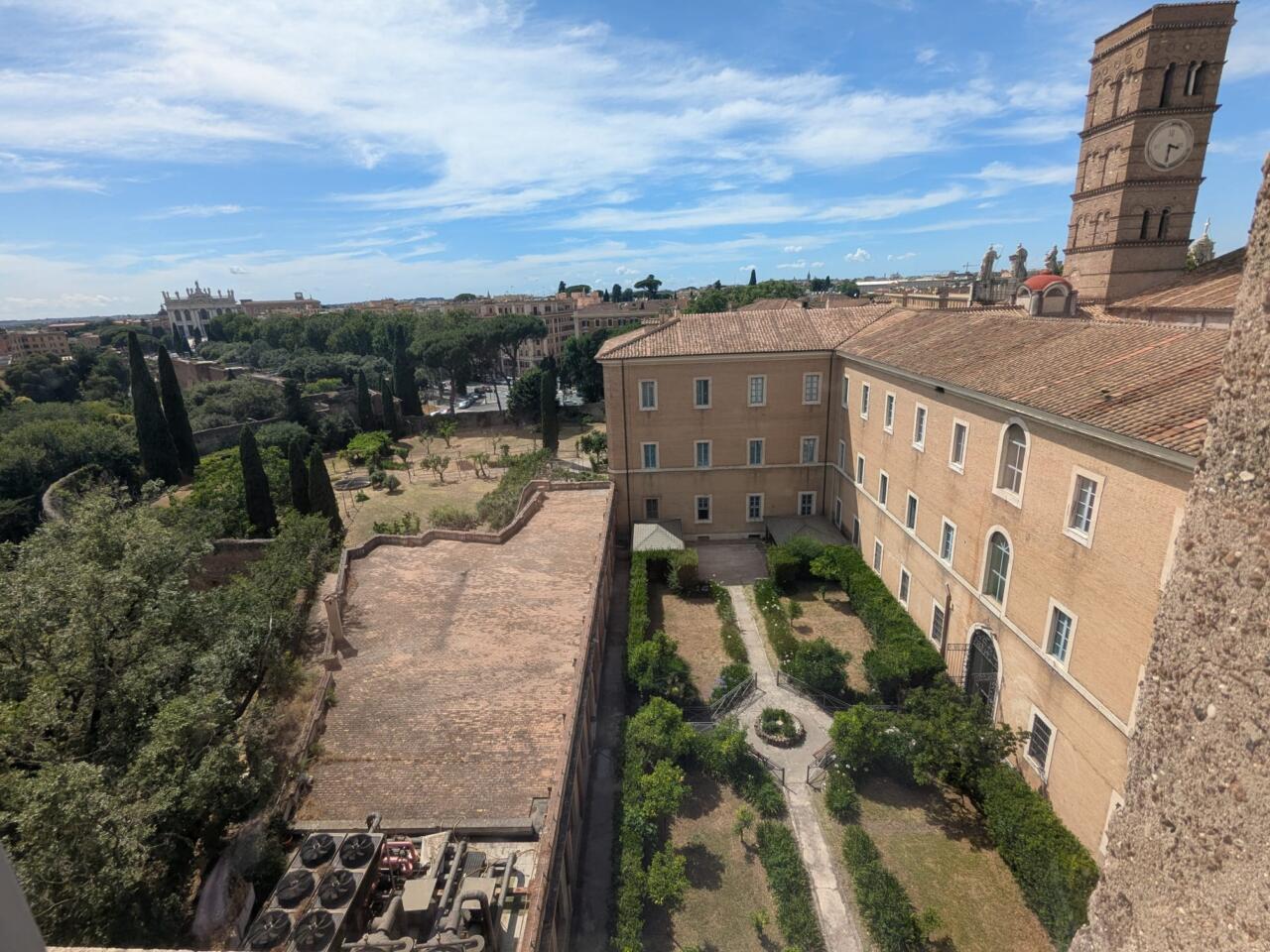
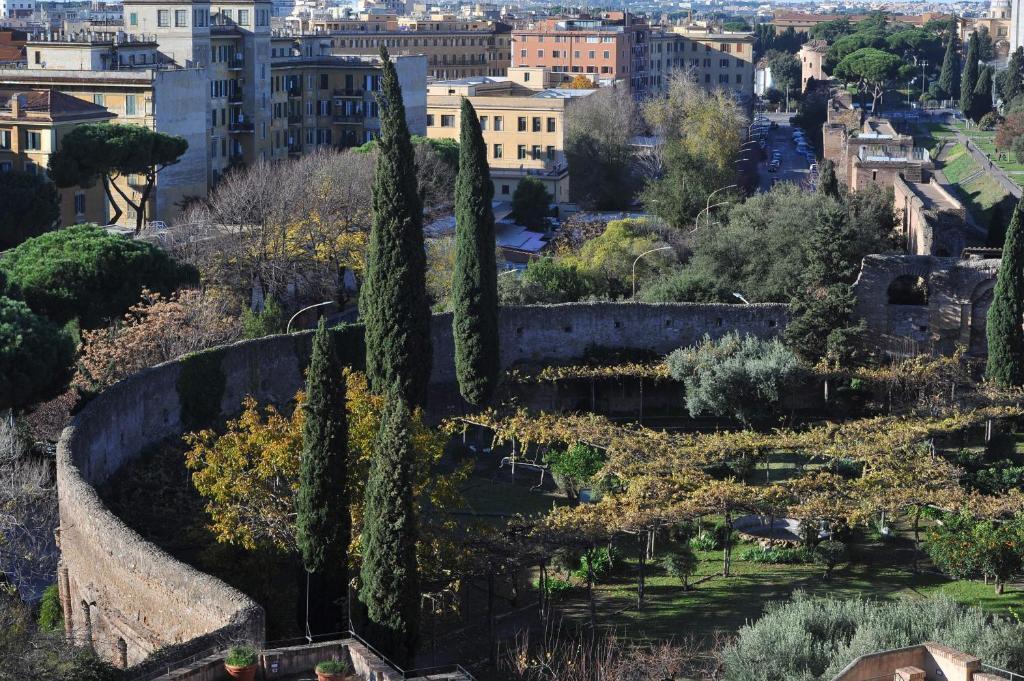
In the area south-east of the Basilica have been brought to light the remains of the Circus Varianus, built after the will of Emperor Heliogabalus (218-222). Adjacent to the Basilica and the Monastery are the remains of the Amphitheatre Castrense which stood on the highest point in the area and was included by Aureliano (270-275) in the defensive enclosure of the Eternal City. Its name comes from Castrum which, in late antique epoch, assumed also the meaning of imperial residence. It was used as the court performances and military exercises. The remains of the Amphitheatre, clearly visible from the roof garden of the Domus Sessoriana, have followed the events of the Monastery which used its materials for the construction of new buildings in the half of the 18th century.
Restoration work
The restoration, rehabilitation and restructuring necessary to promote and ensure the optimal use of the Domus Sessoriana was performed with the aim of ensuring the proper use of the monumental complex in the respect and enhancement of its heritage. The eighteenth century interiors of the Monastery visible today, preserved and restored in their original colors, were the reference point for all interventions in the building. The whitewashed, the terracotta floors, the restoration of the stucco frames of that time, the use of stone and special installation techniques, the use of lighting devices, everything has been made in full compliance with the formal aesthetic genius loci and its cultural stratification.. All works have been performed under the direction of the High Security officials of the Superintendent of The Ministry of Cultural Heritage and Activities and Tourism.
Conventual Wing
The building is divided into two sections. The first, called the Conventual Wing, built on the Roman Walls, comprises a first level containing the lobby, reception, and several areas furnished with sofas for reading or relaxing. From the first level, it’s easy and charming to ascend to the first and second floors, thanks to a modern elevator with a transparent structure that offers views of unparalleled 19th-century paintings. These floors of the Conventual Wing are entirely dedicated to spacious rooms, accessed via an impressive corridor.
The Bell Tower
Using the same elevator, guests access the attic floor where the smaller rooms are located, yet still equipped with the same services and amenities. Some rooms have balconies and views of the Basilica of San Giovanni or the cloister of the Basilica of Santa Croce in Gerusalemme. This then serves as an introduction to the highest level of the building:
The Roof Terrace
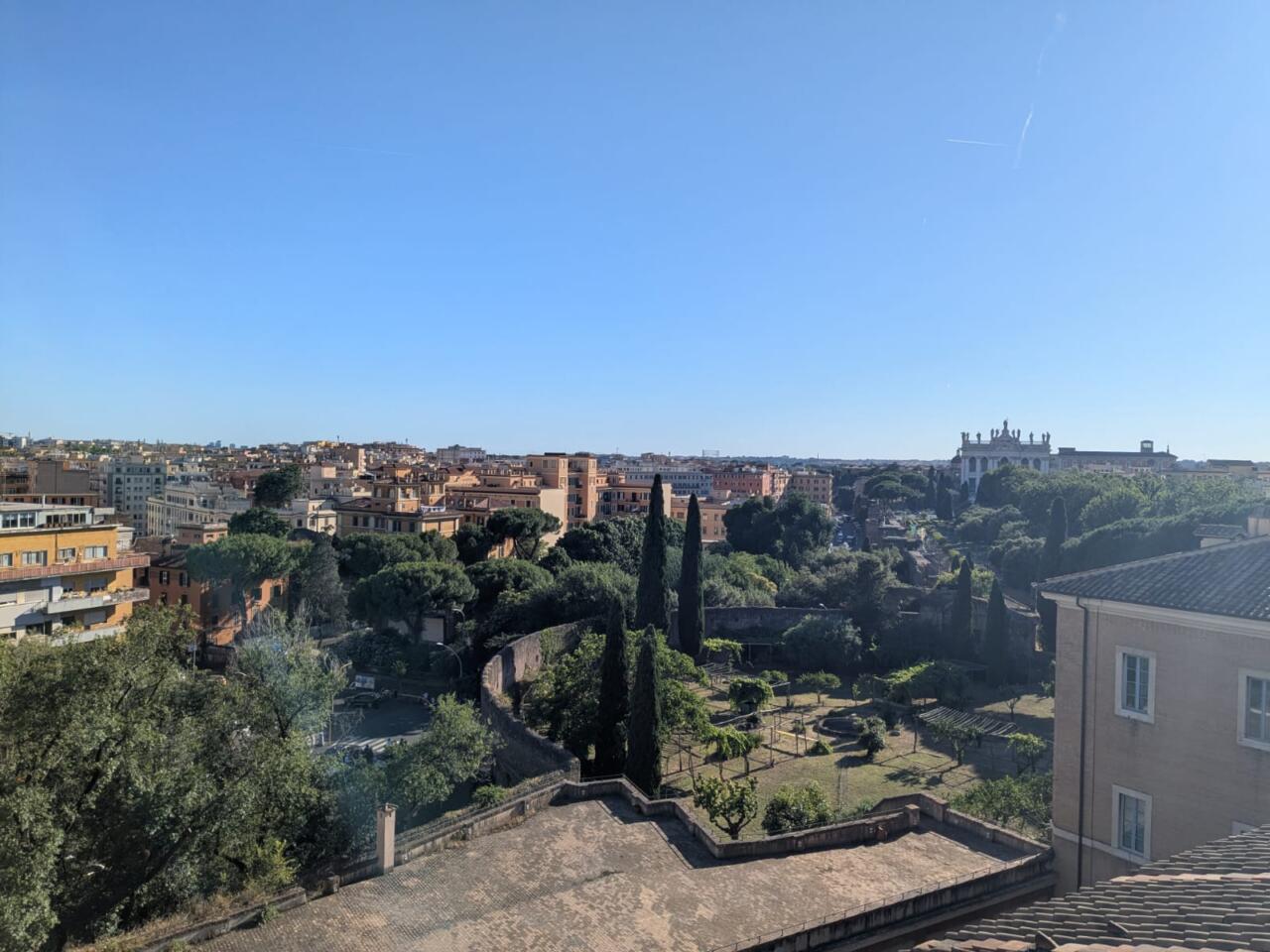
On the highest level is the roof terrace, where guests can enjoy a 360° view of Rome and gaze across centuries of history: from the Monastery gardens, located within the perimeter of the Castrense Amphitheater (the second-largest Roman amphitheater after the Colosseum), the Basilica of San Giovanni in Laterano, and the domes and rooftops of the city. The terrace is divided into an outdoor area and a fully air-conditioned glass-covered area, ideal for winter or hot days. It is accessible to guests throughout the day, so guests can linger there to admire the sunset or sunrise.
Aurelian Wing
The second block, called the Aurelian Wing, is connected to the Conventual Wing by both an external and internal passageway and has five finely furnished floors. It also offers a walk through the archaeological excavations. Recent restoration work has provided the Domus Sessoriana with a larger number of rooms to better meet guest needs. This ambitious project, given the building’s characteristic masonry, was also aimed at providing guests with a free service, an essential part of modern hospitality.
 Private events
 Residences