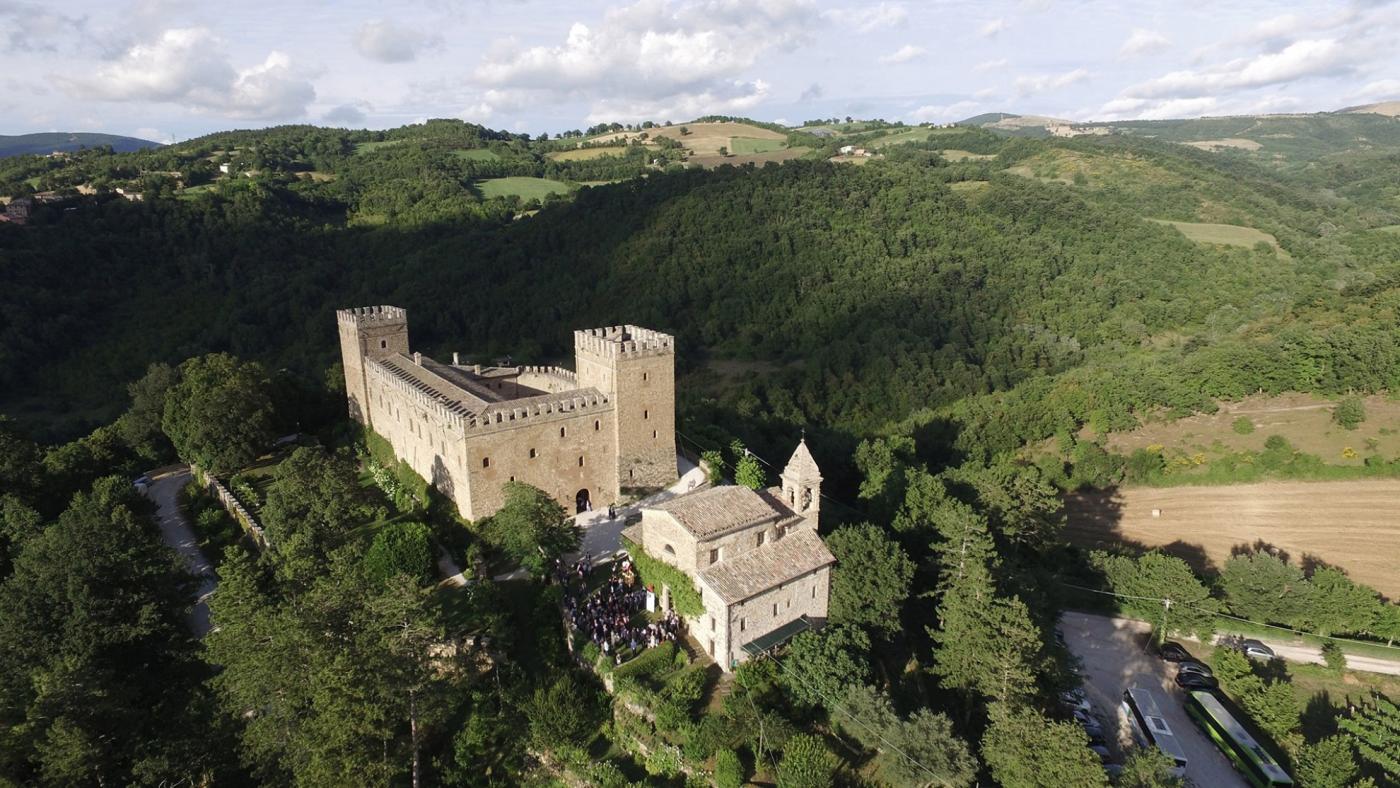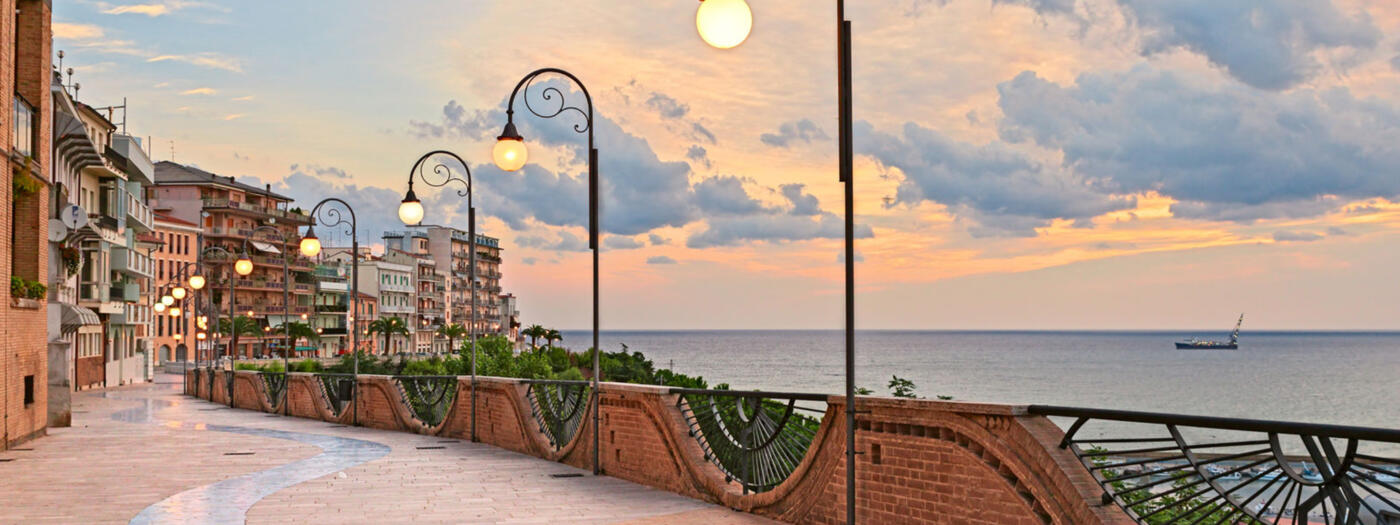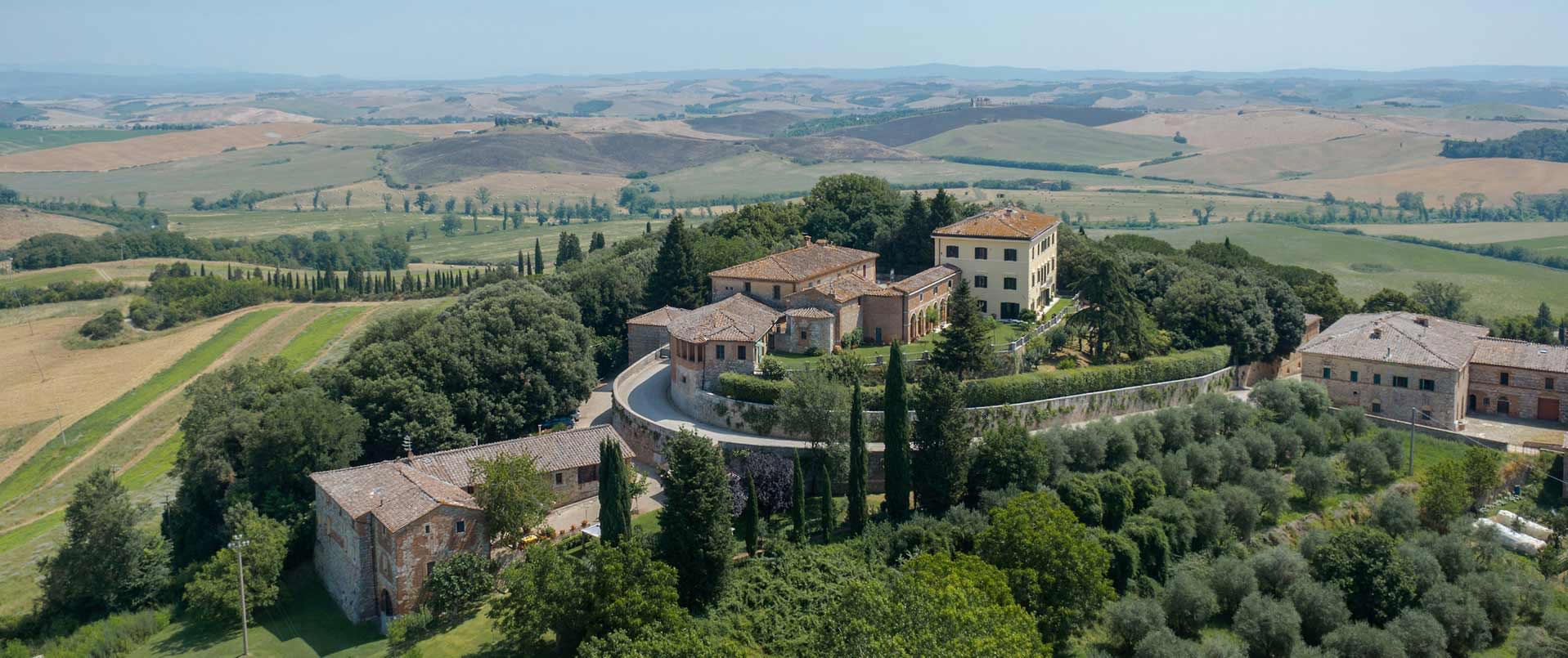
The discovery of the Marche region begins from the coast, which is certainly the area best covered in terms of infrastructure, including roads, highways, and railways. Then, once you turn your gaze inland, the true fascination with a region that can captivate visitors with its authenticity and rich history begins. Land of great poets, painters, and musicians, a treasure trove of artistic heritage and perfectly preserved villages, the Marche is also a reference point for artisanal crafts in Italy and a land of excellent agri-food specialties, starting with those produced organically — a method that was revived here thanks to some far-sighted local entrepreneurs near the border with Romagna, as historically “conventional” methods had never really been practiced.
It is from the northern part of the region that our first Marche itinerary begins — the longest of the three we propose in terms of kilometers, but also the simplest, as it runs almost entirely along the Adriatic Riviera, to be enjoyed during the summer months for those who like to alternate visits to historic residences with some relaxation on the beach, or during the rest of the year for those who prefer to enjoy the region in the off-season without parking difficulties.
The starting point is Pesaro: what better gateway to the Marche? Here, we find the magnificent Ducal Palace, a symbol of lordly authority, Villa Imperiale, one of the most astonishing Renaissance works, and Villa Miralfiore, unique with its gardens and the Fiam Glass Museum — magnificent residences associated with the Sforza and Della Rovere families. Pesaro is a city of bicycles and motors, but above all the City of Music, home to the Rossini Opera Festival, an international event held every August for the past 47 years.
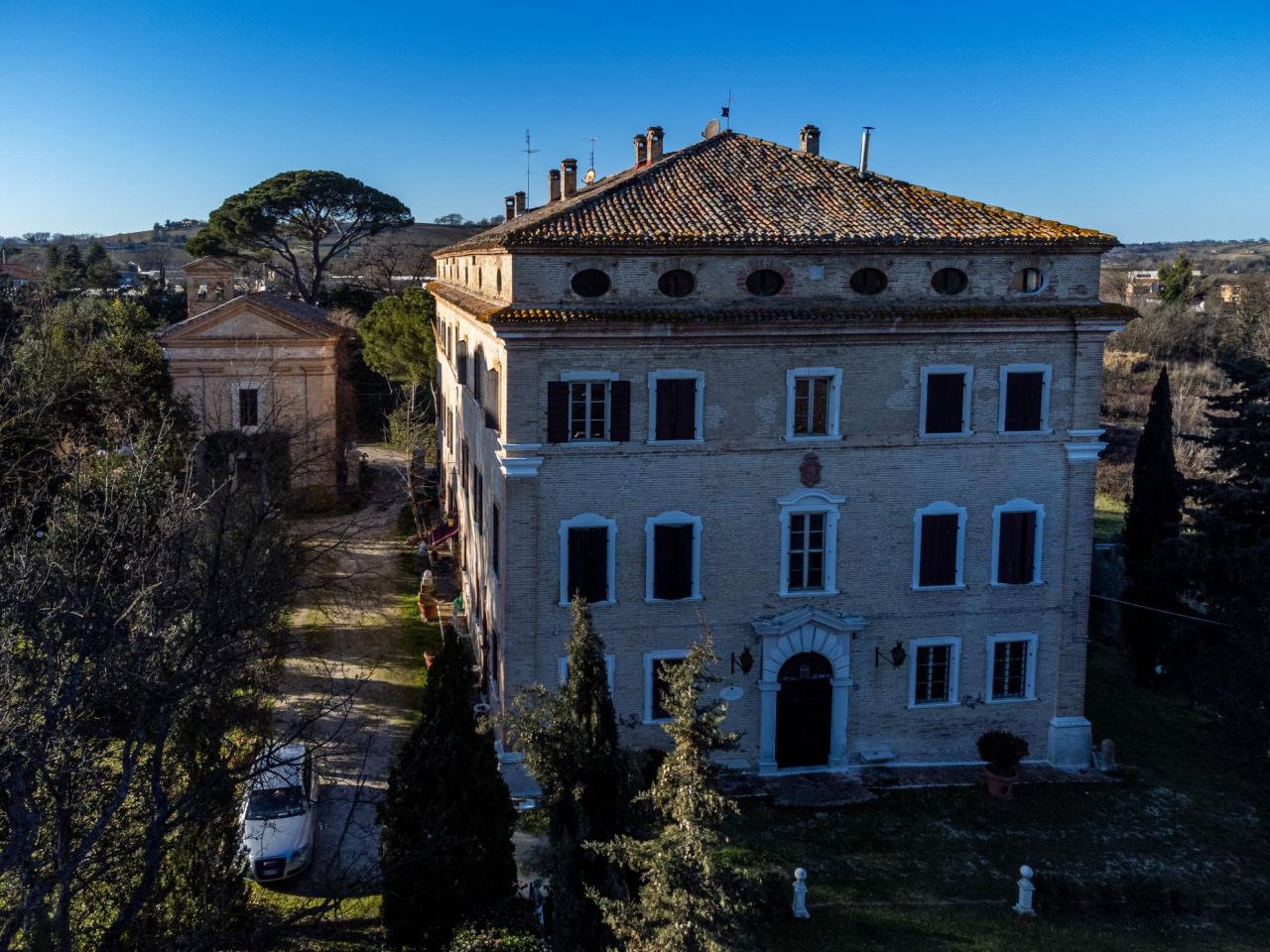
Further south, after traveling 12 km, we reach Fano, a city of Roman origin, with the imposing Arch of Augustus, the endpoint of the Via Flaminia. Like other Marche towns, Fano has an ancient canal-port, along which some mills were present in the 1600s. Inside the walls, originally Roman and later expanded by the Malatesta family, the city reflects the entire history of the region: ancient Rome with the Basilica of Vitruvius — whose recent discovery represents one of the most important elements in architectural history — the Middle Ages with the Malatesta Fortress, towers, and the Sangallo Bastions, and the 17th–18th centuries with palaces of power and noble residences, totaling 53 historic homes. Not to be missed are churches and art galleries housing works by Perugino, Domenichino, Guercino, and Barocci, to name a few.
In Fano, there is Palazzo Castracane, inhabited since the 1400s by the descendants of Castruccio, the Tuscan condottiero remembered by Dante in the Divine Comedy and later by Machiavelli. After significant restoration, it has regained its former splendor; the palace is also frescoed with scenes from Castruccio’s life, as described by Niccolò Machiavelli. The Hall of the Sun is an architectural and artistic jewel that enchants visitors with its majestic beauty and profound historical significance.
Continuing south, we reach Senigallia, one of the most famous towns on the Marche coast, home to the renowned “Rotonda sul Mare,” and now well known among fine dining enthusiasts for two of the region’s most important gourmet restaurants, also famous nationwide: Uliassi (three Michelin stars), with Mauro Uliassi in the kitchen and his sister Catia in the dining room, and La Madonnina del Pescatore (two stars), by chef and entrepreneur Moreno Cedroni. Beyond fine dining, Senigallia boasts the “Velvet Beach,” named for its soft sand, and a famous fortress called “Roveresca,” commissioned by the Della Rovere family, along with several other civil and religious landmarks. In the surrounding area, several villages are worth visiting, especially Corinaldo, with its perfectly preserved walls and a historic center that houses the first of many Italian-style theaters, in this case, the Teatro Goldoni — one we will encounter again in the region, as the Marche are considered the “land of a hundred theaters.”
In Corinaldo, you can also visit the birthplace of its most famous “daughter,” Saint Maria Goretti, born here on October 16, 1890.
Before leaving Senigallia, a couple of suggestions: for dessert and ice cream lovers, there is Paolo Brunelli’s shop, a national reference point in this sweet domain; for those interested in artistic jewelry, there is Franco Staccioli’s workshop in the city center.
From Senigallia, we continue to Ancona to discover the wonders of the regional capital of the Marche. We travel without stops because the coastline between the two cities is less scenic, passing through an industrial and port area. Entry into Ancona can be via the hills if taking the highway or via the port, with views of the Mole Vanvitelliana, if using State Road 16. Ancona deserves at least a day of visiting, including a break at Passetto Beach. For overnight stays, we suggest the Grand Hotel Palace, in a recently renovated historic building.
Major attractions in Ancona include, besides the already mentioned Mole — once used to quarantine the sick — the Teatro delle Muse in Neoclassical style, and the Loggia dei Mercanti, historically the site of commercial negotiations in the port area. Heading toward the city center, albeit with some effort due to the incline, you find the most important church, the Cathedral of San Ciriaco, built from white and pink Conero stone, offering the best panoramic views of the city. Nearby are the remains of the Roman Amphitheater, which could host up to 10,000 spectators. From here, our walk continues for about half an hour, extending through the main shopping street, Corso Garibaldi, passing Piazza Cavour and Viale della Vittoria, until reaching Passetto, where beyond the World War I monument, the sea finally appears, accessible via a grand staircase. The beach here is rather simple, but for more comfort, one can move to Portonovo, an enchanting bay in the Conero Park, with well-known beach resorts like La Capannina di Portonovo.

Leaving Ancona, we follow the coast, passing the tourist towns of Sirolo, Numana, and Marcelli, until we begin to glimpse the main pilgrimage site of the Marche: the Sanctuary of the Madonna of Loreto, crucial to Christianity as it houses the Holy House of Nazareth where Mary was born. According to tradition, the three stone walls were transported to Loreto in 1294 when the Crusaders were expelled from Palestine. Not far from Loreto is the village of Recanati, birthplace of Italy’s greatest 19th-century poet, Giacomo Leopardi, now a house-museum where visitors can explore the “mad and desperate” study areas, including the monumental library created by his father Monaldo’s collection of precious volumes.
After so much culture, a gourmet lunch is deserved, and the choice is obvious: Andreina in Loreto, thanks to chef and owner Errico Recanati, featuring his iconic charcoal cacio e pepe pasta.
After visiting Civitanova Marche, particularly the upper town (with the historic Annibal Caro Theater, Moretti Municipal Art Gallery, the former Church of Sant’Agostino, the Liberty-style Tram Station, the Museum of Popular Arts and Traditions, and the Historical Trot Museum), we enter the province of Fermo.
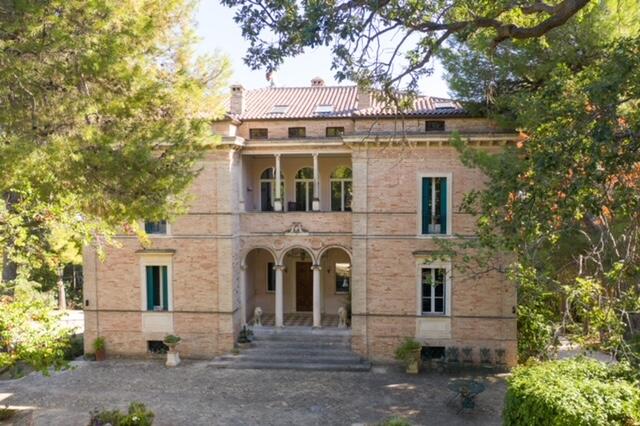
A few kilometers away is the third residence, but be warned: this area of the Marche has many pleasant temptations for shoe enthusiasts, being home to Italy’s most important footwear district, with numerous factory outlets, including the famous Tod’s Group outlet in Casette d’Ete, and many others along the way for men, women, and children (especially in Monte Urano). Returning to the residence, it is located in Porto San Giorgio, the main seaside resort of the Fermo area: Villa Santa Maria al Poggio. Built in the second half of the 19th century on the remains of an ancient Fermo watchtower, not far from Porto San Giorgio (once called the “port of Fermo”), it is a neo-Renaissance residence spanning four floors, each with its own personality and charm. Inside are a library, a votive chapel, and a large central hall used for meetings and balls, as well as three suites available to guests. The villa is available for events and ceremonies.
The journey ends in nearby San Benedetto del Tronto, the main town of the so-called Riviera delle Palme, for a lunch or dinner of fresh seafood. After all, it is one of Italy’s fishing capitals, ranking ninth nationally, although Ancona remains the most important Marche port in third place nationally. Recommended dining includes the smart restaurant of the local fishermen’s cooperative, Ristoro al Porto, or alternatively the trattorias Da Zia Cicci or Da Rita.